BIZA · Point of sale
Electronics & mobileThe unit you sold, not one like it
For mobile phone shops, electronics and appliance retailers · September 2026
A customer comes back with a handset and a warranty claim. Somewhere there is a box with the IMEI written on it, a receipt with only a model name, and a supplier who wants to know exactly which unit this was.
Here the serial number was chosen at the point of sale, printed on the slip, and is on the invoice line. The return brings that unit back — not a unit like it.
What a serialised counter needs
Serial numbers, chosen at the counter
Mark a product as serial-tracked and every sale asks which unit. Scanning the IMEI or serial adds that unit directly; typing a few characters finds it. The line is exactly one unit, and the server checks the serial again when the sale posts, so two counters cannot sell the same handset.
- Scan or search the serial to add the unit
- One unit per line, enforced
- On-hand list per location
- Server re-validates on sync
- Accessories and SIM packs sell normally alongside
- Batch tracking for anything sold by lot
The trail a warranty claim needs
The serial prints on the receipt, stays on the invoice line and lives in the lot ledger with every movement it has made. When a unit comes back, the refund restocks that serial; when a supplier asks which unit, the answer is one query, not a shoebox.
- Serial on the receipt and the invoice line
- Movement history per unit, per location
- Returns restock the exact serial
- Credit note against the original invoice
- Store credit or cash refund, your choice
- Supplier returns handled in Purchasing
Price moves, with a name against them
Electronics is a negotiated counter. Changing a price is a permission the server enforces; the original list price stays on the line so the discount is visible in the margin report rather than hidden inside a lower price, and the dashboard flags a shift with an unusual rate of overrides.
- Price override permission, per user
- List price kept beside the sold price
- Discounts posted to their own account
- Manual-discount rate flagged per shift
- Customer groups and price lists for trade buyers
- Quantity breaks for bulk accessory sales
Gift cards, store credit and trade-ins
Gift cards are sold from the cart and post to a liability, not revenue, until they are spent. A return can be refunded as store credit on a card in the customer name — useful when a unit comes back and a replacement is not in stock today.
- Gift cards sold, reloaded, voided and redeemed
- Store credit issued on a return
- Balances checked live at the counter
- Printed on the slip with the remaining balance
- Points earned and redeemed as a tender
- Liability accounts kept straight by the server
- Trade-ins into stock at the agreed value, with the IMEI
Stock that tells the truth across branches
Each counter sells from its branch location. A unit that is not here but is in the other branch shows as not stocked here rather than as available, and a transfer moves it properly. Backordered items can still be sold where the product allows it.
- A stock location per counter
- Not stocked, low stock and out of stock shown per branch
- Branch transfers from the counter menu
- Backorder where the product permits it
- Purchase orders and landed costs on the same catalogue
- Margin by product and by branch
A day on a phone-shop counter
- 10:00Open the counter with a float; the display faces the customer.
- 10:25A handset is sold: the IMEI is scanned, the unit leaves stock, the serial prints on the slip.
- 12:10A negotiated 40.00 off is keyed. The list price stays on the line; the discount posts to its own account.
- 15:30A screen protector is added to an existing bill by splitting the order.
- 16:45A warranty return: the same IMEI comes back, the credit note is raised and the unit is back on hand.
- 19:00A gift card is sold for 200.00 — a liability, not revenue, until it is spent.
- 22:00Close the counter; the dashboard shows the override rate for the shift.
What the books get
A 1,998.00 handset sale with 15% VAT, 40.00 discounted, paid by card:
Specification
| Serialisation | Per product: none, serial number, or batch with expiry; scan-to-sell by serial; one unit per line; exact-unit returns; lot ledger with every movement per location |
| Devices | Windows, macOS and Linux desktop app; iPad and Android tablet; phone; any browser, installable as a web app |
| Printing | ESC/POS thermal printers over the network, or USB / serial / Bluetooth through the computer's print queue; 58 mm and 80 mm; cash drawer opens on cash sales |
| Tenders | Cash, card, bank transfer, gift card, store credit, loyalty points and on account (the balance stays on the customer's receivable); mada in Saudi Arabia, UPI with a scan-to-pay QR in India; split across any number, each banked to the account you choose |
| Cash control | Shifts per counter with a counted float, cash in / out with reasons, blind count at close, X and Z reports, variance, cashier PIN switch, audited drawer opens |
| Offline | Every sale, return and cash movement queues on the device and posts exactly once when the connection returns |
| Compliance | ZATCA Phase 1 QR and Phase 2 clearance (Saudi Arabia), GSTIN with HSN/SAC and a UPI QR (India), TRN (UAE), plain receipts elsewhere |
| New | Warranty lookup by serial or IMEI with claims; trade-in tender into stock; account payments at the counter |
New at this counter
What the counter now does for the unit you sold:
- Warranty by serial or IMEI. Look a unit up and see which sale it came from, who bought it, and whether it is still covered; log a claim and follow it from received to returned.
- Trade-ins at the counter. The customer’s old handset pays part of the bill: it goes into stock at the agreed value, with its IMEI and condition grade, and no cash leaves the drawer.
- Account customers settle at the counter, oldest invoices first, through the same receipts the back office uses.
- Loyalty tiers and punch cards for the accessory buyers who come back.
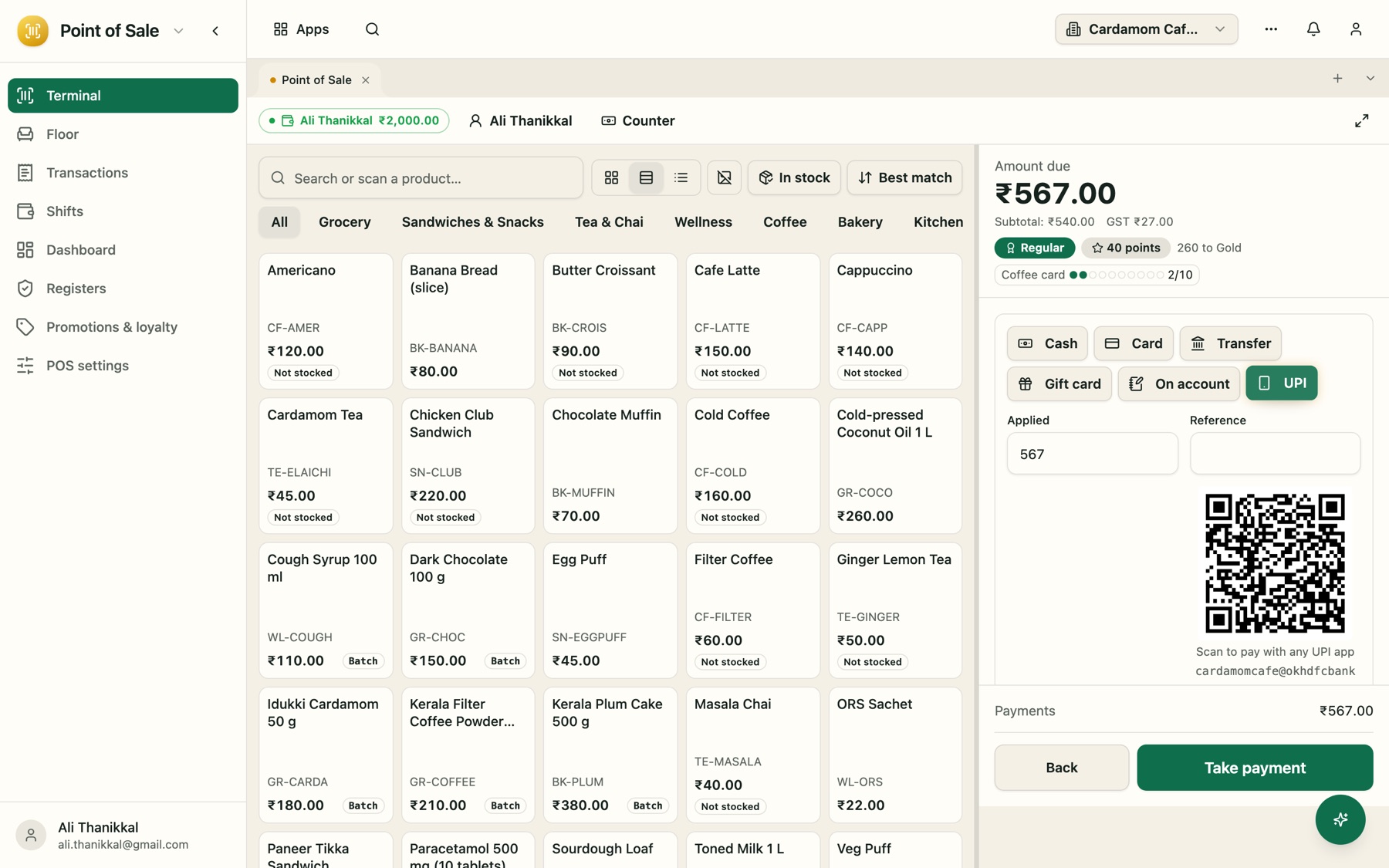
Integrations on request: carrier and manufacturer IMEI databases, and card terminals from your country’s acquirer (Geidea and mada in Saudi Arabia, Pine Labs and Razorpay in India, Stripe elsewhere).
The whole counter
Everything above sits on one product. This is all of it, the same in every edition, whether or not your counter needs each part on day one.
Selling
- Search by name, SKU or barcode; category chips; sort by best-selling or recently sold
- Variants on one card, with a picker; a variant barcode adds that variant directly
- USB and Bluetooth scanners with no setup; camera scanning in the mobile app
- Keyboard shortcuts: F2 search, F4 pay, F6 park, F8 returns, F9 exact cash
- Line and cart discounts, and price overrides, each behind its own permission
- Sold by the piece, kg, metre or litre; weight and price labels from scales
- Options with minimum and maximum choices, priced on the line
- Park a cart with a note and resume it on any counter
- A second screen for the customer; a self-checkout kiosk
- Full-screen register mode; phone and tablet layouts built for touch
Payments
- Cash with quick-amount chips, a keypad and exact cash; change worked out
- Card and bank transfer with a reference, banked to the account you choose
- Gift cards, store credit and loyalty points as tenders
- On account, within the customer’s credit limit
- mada in Saudi Arabia; UPI with a scan-to-pay QR in India
- Split one bill across any number of tenders
- Tips to a liability, never revenue; a service charge by percentage
- Account payments at the counter, oldest invoice first
- Trade-ins and charge-to-room, where the counter uses them
Receipts
- 58 mm and 80 mm thermal slips, printed as an image so every script prints as shown
- Auto-print, and the drawer opens on cash sales
- Email with the invoice PDF attached; WhatsApp with a link to it
- Reprint any sale from Transactions
- The receipt title, tax number and fiscal QR your country requires
- Serial, batch, expiry and HSN on the lines that need them
Customers and loyalty
- Walk-in by default; any customer from the address book in one search
- Customer groups, with their own promotions and price lists
- Price lists with quantity breaks, by group or by counter
- Promotions: percent off, amount off, fixed price, buy X get Y, N for X
- Schedules, days, hours, limits and coupon codes that say why they did not apply
- Points, tiers with multipliers, and punch cards that pay out as store credit
- Gift cards sold, reloaded and voided, booked as a liability
Stock
- Each counter sells from its own location, with live on-hand on every card
- Low stock, out of stock, not stocked here and backorder, per product
- Serial numbers and batches with expiry, soonest-expiry first
- Returns put back the exact unit or batch that came back
- Recipes that take ingredients off the shelf, costed first-in-first-out
- Transfer stock between locations from the counter
- Price and product changes reach open counters without a reload
Cash and trust
- Shifts per counter with a counted float
- Cash in and out with reasons; a mistake is voided with a reversing entry
- Blind count at close, X and Z reports, and the variance
- Every cashier is a real user; switch by PIN, lock the counter to step away
- Permissions checked by the database, not just the screen
- Voids, no-sale drawer opens and sign-ins recorded with a name
Returns
- Return any line or all of them, against the original sale
- Refund in cash, as a credit on the account, or as store credit
- A credit note every time, with its own number
- Returns work offline against the counter’s own copy of the sale
Tables and kitchen
- Floors and tables with seats; table states: free, seated, not sent, bill printed
- Move or merge tables, or move some items onto another table’s bill; the kitchen gets a slip
- Kitchen tickets per station, printed and on a kitchen screen, in rounds
- A kitchen log with time to plate, reprints and cancelled tickets
- Courses and seats; split by item or seat; print the bill before paying
- Comps with a reason, a daily limit per person, a manager PIN past it, and a report
- Guests order from the table by QR, from the categories you choose
- Pickup and delivery orders, with a delivery charge added for you
- Reservations and a waitlist; tips paid out to each server
Offline
- Sales, returns, cash movements and shift open and close all work offline
- Everything queues on the device and posts exactly once when the line returns
- Anything the server refuses stays visible, with the reason, until someone acts
Oversight
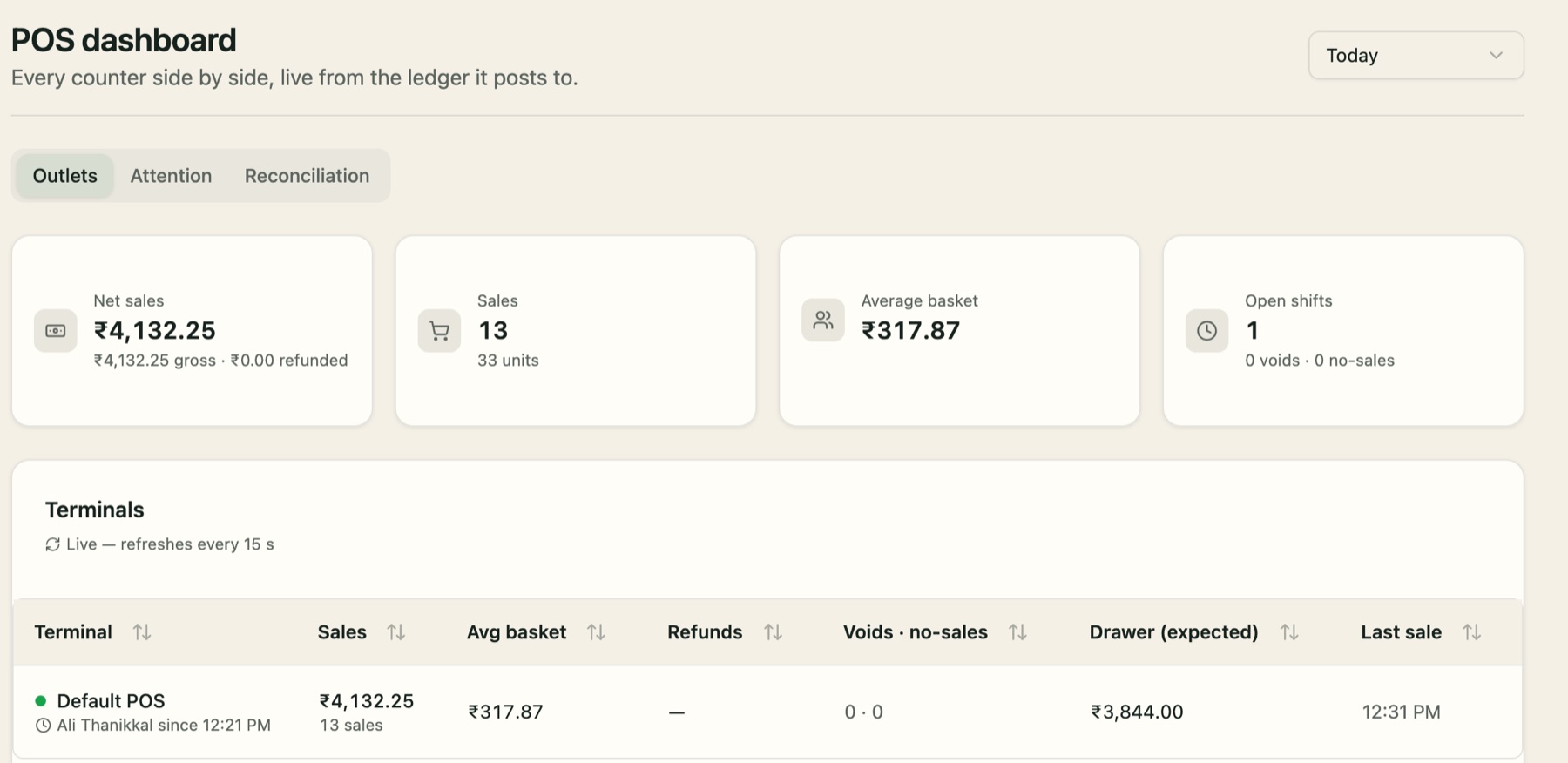
- A live dashboard of every counter and outlet, refreshed every 15 seconds
- Sales by hour, tender mix and top items
- Attention flags at thresholds you set: variance, voids, refunds, discounts, no-sales
- Reconciliation: what the counters took against the ledger and the journal
- Reports for tips, comps and ingredient shortfalls
Compliance
- ZATCA Phase 1 QR and Phase 2 clearance in Saudi Arabia
- GSTIN with HSN/SAC in India; TRN in the UAE; VAT numbers elsewhere
- Age checks and prescriptions before the line goes on the bill
- A controlled-drug register, batch recalls and warranty checks by serial
Devices and hardware
- Desktop app for Windows, macOS and Linux
- iPad and Android tablets, and phones; or any browser, installable
- ESC/POS printers on the network, or USB, serial and Bluetooth through the computer
- Cash drawers on the printer’s port; ticket printers per kitchen station
Screens from a demo workspace, “Cardamom Cafe & Store” in Kochi.
See it on your own counter
Start a free trial at my.biza.app, or ask for a walkthrough with your own stock, real serials and a scanner. The POS guides are at biza.app/docs.