BIZA · Point of sale
RestaurantTables, kitchen and bill on one order
For full-service restaurants, dining rooms and casual dining · September 2026
Saturday, 8:30 pm. Every table is full, the captain is running KOTs to the kitchen by hand, table 7 has waited forty minutes for a biryani nobody saw, and at closing the cash does not match the bills. You find out what went wrong tomorrow — if you find out at all.
With BIZA the captain takes the order on a phone, the kitchen sees it the moment it is sent, and the bill is ready when the table is. You see every table, every dish on the house and every payment — from the counter or from your own phone.
What a dining room needs
A floor that is the list of open orders
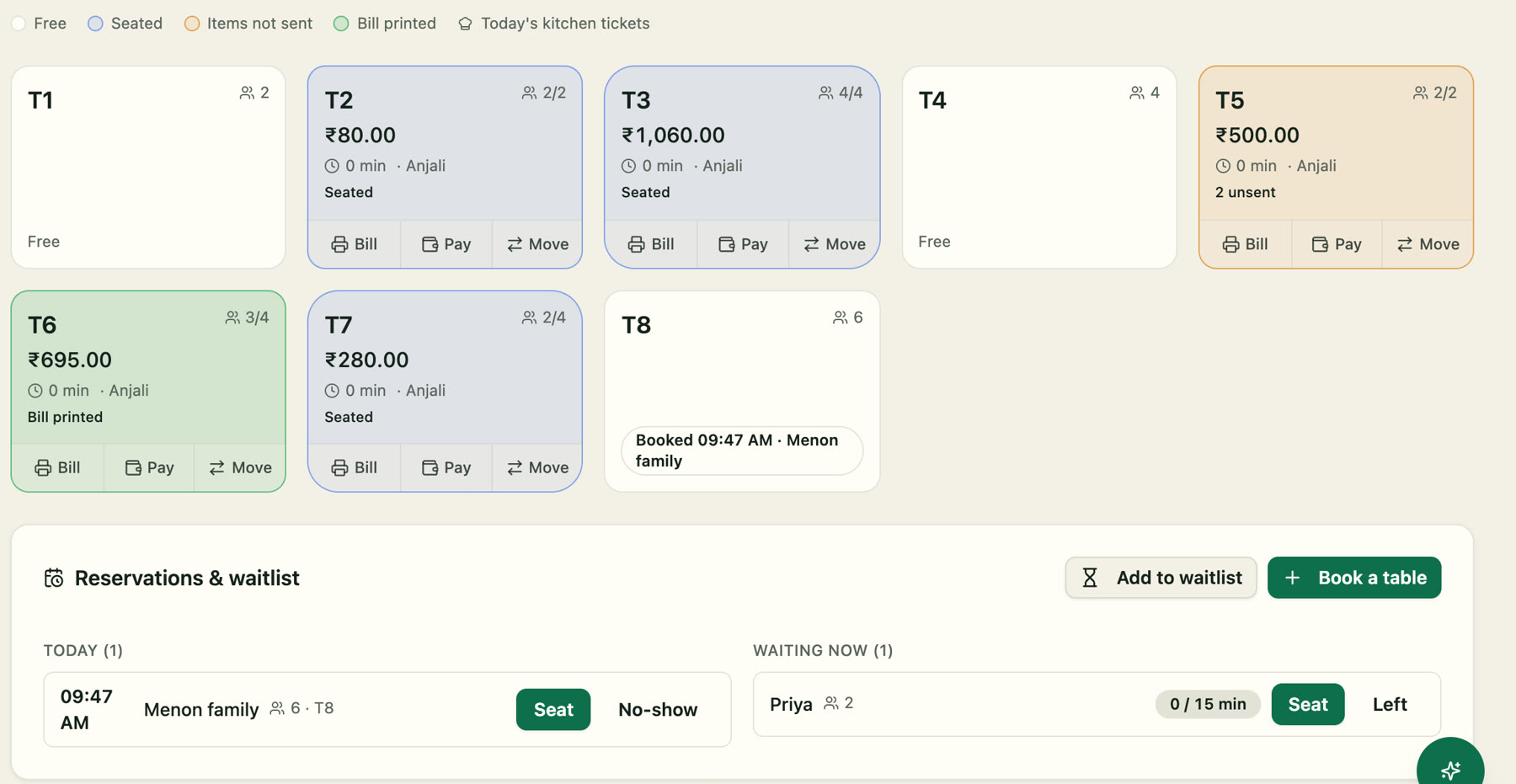
Tables are laid out by floor with their seats and their state — free, seated, items not yet sent, bill printed — with the time since the table opened and a badge when a guest has ordered from the QR code. Bill, Pay and Move work straight from the table. A party that moves to the terrace takes its order and its open kitchen tickets with it; two tables that join become one bill. Orders belong to the restaurant, not to a device, so any counter, tablet or phone can continue them.
- Floors, tables, seats and shapes
- Table states with a legend, and time open
- Bill, Pay and Move from the table itself
- Move a party, or merge two tables into one bill
- Move some items onto another table’s bill
- The kitchen gets a slip: T3 → T8, with its tickets
- Walk-up, pickup and delivery orders alongside the tables
- Any device can pick up any order
- Close an order without a bill, with a reason
Modifiers that cannot be under-priced
Size, cooking level, extras and swaps are option groups on the product with minimum and maximum choices and their own price differences. The price change is applied on the device and re-applied on the server, so a tampered device cannot sell a large at the small price.
- Option groups with min / max choices
- Price differences per option
- Attached per product, managed in one place
- Shown on the kitchen ticket
- Works at the counter, on the phone and on the guest QR page
- Re-checked server-side on every sale
The kitchen gets tickets, not shouting
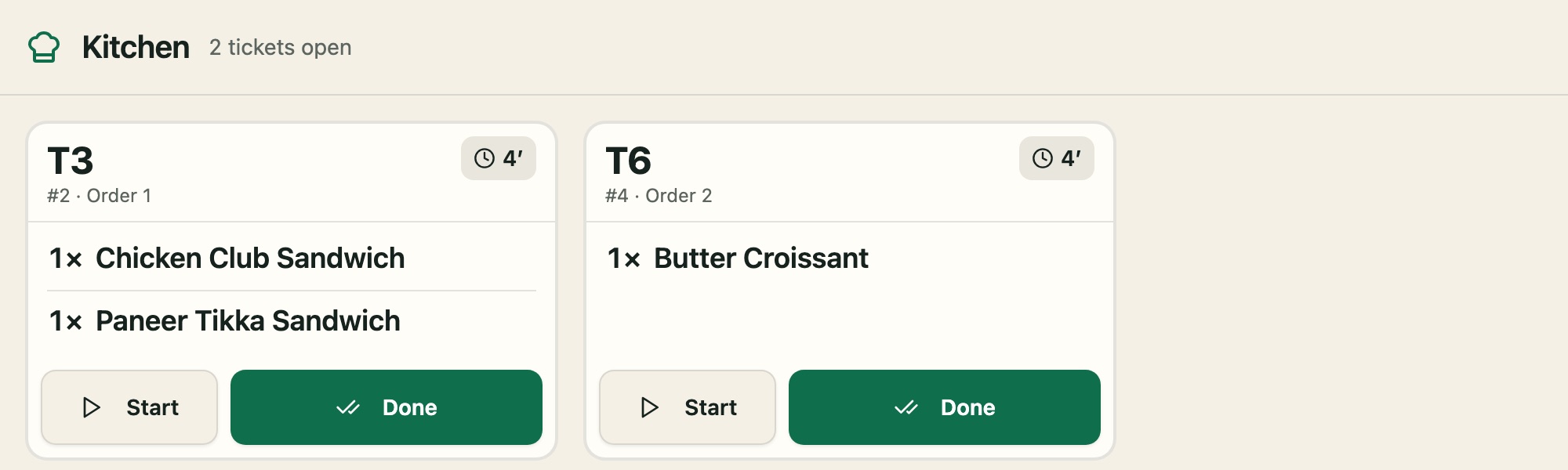
Send to kitchen creates one ticket per station from the same order — the bar sees drinks, the grill sees mains — printed on that station's printer and shown on its display. Lines the kitchen already has are marked, and removing one needs a reason that becomes an audited event.
- Stations defined by the categories they cook
- A ticket per station, printed and on screen
- Start, Done and bring-back on the kitchen display
- Course and seat on every ticket
- Ticket number, table and server printed
- Rounds: send again as the meal goes on
- A kitchen log of the day: time to plate per ticket
- Reprint a ticket, or cancel one the kitchen has not started
Splitting, tips and service charge, done properly
The bill can be printed for the table before anyone pays — clearly marked as not a tax invoice, and the table shows it has gone out. Split picks lines or a whole seat to bill now; the remainder stays open on the table as the next bill. A tip is posted to Tips Payable and never touches revenue or tax. A service charge is a configurable percentage with its own revenue account, taxed or not as you decide, and optionally dine-in only.
- Print the bill for the table before payment
- Split by item or by seat, as many times as needed
- Tip presets, no tip, or a typed amount
- Tips report by server and by tender
- Service charge percentage, taxable flag, dine-in only
- Removable per bill by a cashier with the right
- Gift cards, points, mada and UPI work at the table
Waiters carry the counter in one hand
On a phone the same system shows the menu, the order and a Send button in the thumb bar whenever there are unsent lines; after sending it returns to the floor. Menu, table, send, next table — no separate handheld product and nothing to reconcile between them.
- One-hand phone layout with 44 px targets
- Send to kitchen from the thumb bar
- Back to the floor automatically after sending
- Camera scanning for packaged items
- Works on the house Wi-Fi or on mobile data
- Offline: the round queues and posts when signal returns
Guests can order from the table, without an app
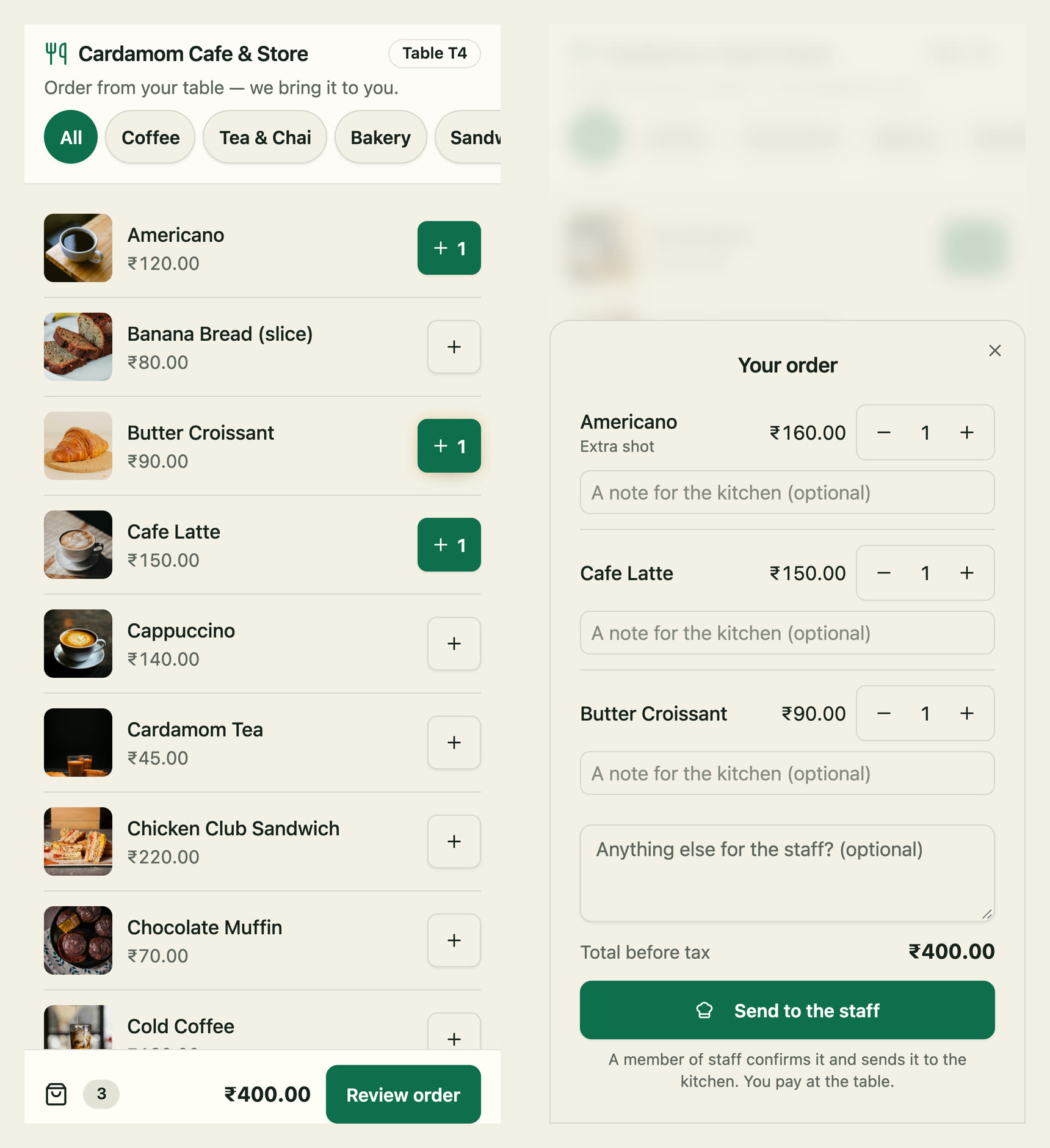
Each table carries a QR code that opens a public menu page: photos, options, a note per dish and a note for the staff. The order lands on the table as unsent lines, so a server reviews it before the kitchen sees it. No app to install, no payment taken on the guest page, and a leaked code is rotated in one tap.
- A public page per table, keyed by a rotating token
- Photos, categories and modifiers
- Lands unsent so staff stay in control
- Guest sees what is in the kitchen and what is with staff
- Throttled per table
- Switched on or off per restaurant
- You choose which categories guests see
Comps that someone answers for
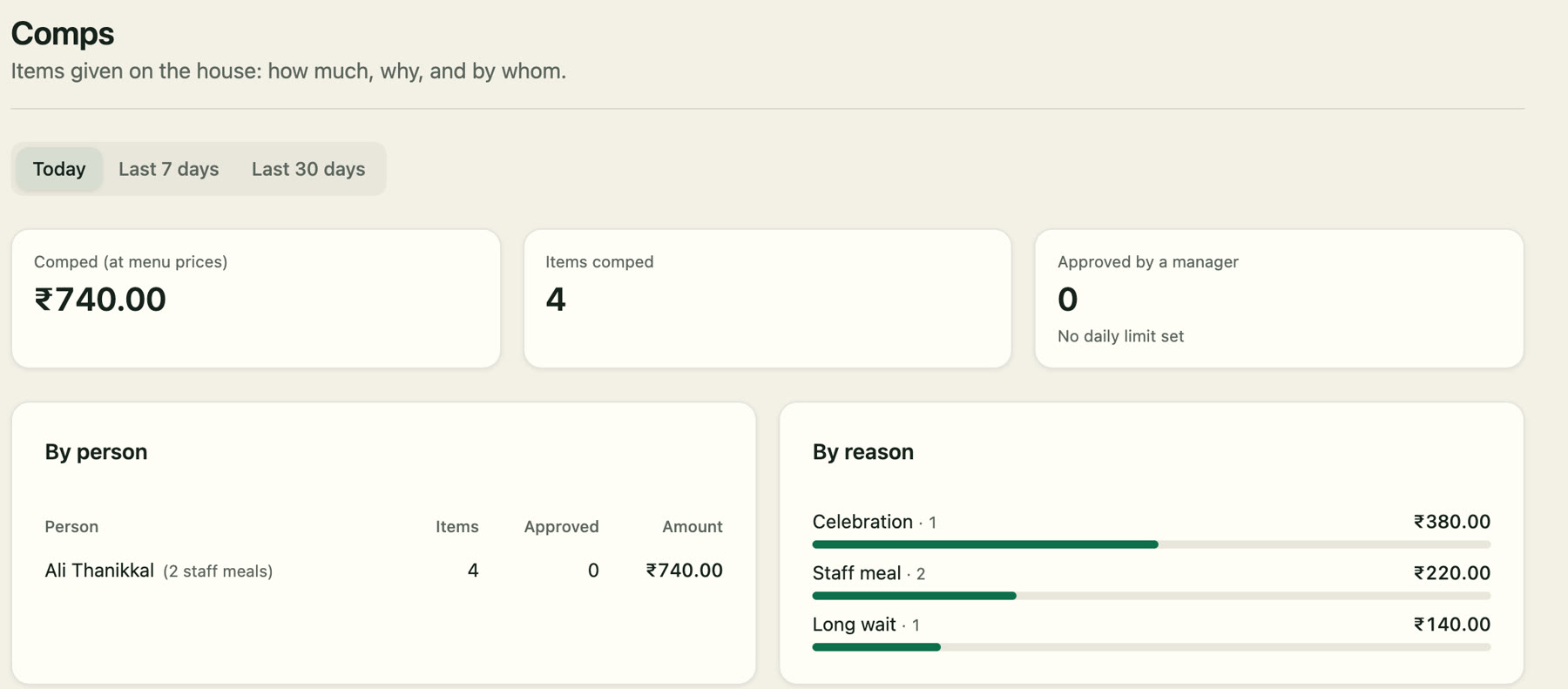
Putting a dish on the house takes a reason — a quality issue, a long wait, a celebration, a manager’s call — and the name of whoever did it. Set a daily comp limit per person and anything past it needs a manager’s PIN. A staff meal is booked as a Staff Meals expense rather than a discount to a customer, and the Comps report shows how much went out, why, and by whom.
- A reason and a name on every comp
- Daily limit per person, in the venue’s own day
- Manager PIN to go past it, with who approved
- Staff meals to an expense account, not a discount
- Comps report by person and by reason
- Shown on the bill as on the house
A service, from door to bill
- 11:45Open the counter with a float. The floor shows every table free.
- 12:40Table 6 is seated for four. The server takes the order on a phone and sends it.
- 12:41The bar prints two drinks, the grill prints three mains. Both appear on the kitchen displays.
- 13:10A second round is added to the same order and sent. The first round is already marked done.
- 13:20The mains ran late, so the manager comps the desserts with the reason “long wait”.
- 13:30The bill is printed for the table; it shows as bill printed on the floor.
- 13:35Two guests need to leave. Their seats are split onto a bill, paid by card with a 10% tip.
- 13:55The rest of the table pays cash with a service charge; the table frees itself.
- 23:30Close the counter. The tips report says what each server is owed; the day is already in the ledger.
What the books get
A 240.00 dine-in bill with 15% VAT, a 10% service charge and a 20.00 tip, paid half cash and half card:
Specification
| Restaurant | Floors, tables and seats with table states; move and merge tables, move items between bills; modifiers; orders sent in rounds; kitchen tickets and display per station; courses and seats; bill printed before payment; split by item or seat; tips; service charge; comps with limits; waiter phones; QR ordering at the table; pickup and delivery orders |
| Kitchen | A station per category with an optional ticket printer; a default station catches the rest; Start / Done / bring back; a day’s log with time to plate, reprint and cancel; removal of a sent line requires a reason |
| Devices | Windows, macOS and Linux desktop app; iPad and Android tablet; phone; any browser, installable as a web app |
| Printing | ESC/POS thermal printers over the network, or USB / serial / Bluetooth through the computer's print queue; 58 mm and 80 mm; cash drawer opens on cash sales |
| Tenders | Cash, card, bank transfer, gift card, store credit, loyalty points and on account (the balance stays on the customer's receivable); mada in Saudi Arabia, UPI with a scan-to-pay QR in India; split across any number, each banked to the account you choose |
| Cash control | Shifts per counter with a counted float, cash in / out with reasons, blind count at close, X and Z reports, variance, cashier PIN switch, audited drawer opens |
| Offline | Every sale, return and cash movement queues on the device and posts exactly once when the connection returns |
| Compliance | ZATCA Phase 1 QR and Phase 2 clearance (Saudi Arabia), GSTIN with HSN/SAC and a UPI QR (India), TRN (UAE), plain receipts elsewhere |
| New | Table states, move and merge; comps with a daily limit and a report; staff meals; printed bill; delivery orders; kitchen log; reservations and waitlist; recipes that deduct ingredients; tips paid out; order-ahead pickup |
New at this counter
What the dining room now has:
- Tables that move and merge. Move a party to another table, merge two tables into one bill, or move a few items onto someone else’s; the open kitchen tickets follow, and each station prints a slip saying where they went. Every table shows its state: free, seated, not sent, bill printed.
- Comps with a limit and a report. A reason and a name on every dish on the house, a daily limit per person with a manager PIN past it, staff meals booked as an expense, and a report by person and reason.
- The bill before the payment. Print the bill for the table, clearly not a tax invoice; the tax invoice follows when it is paid.
- Delivery and pickup at the counter. Take a phone order for delivery with the customer’s contact and address, or for pickup, next to the tables. The delivery charge goes on by itself and never reaches the kitchen.
- A guest menu you choose. Pick the categories the table QR and pickup menus show, so the retail shelf stays off the dining menu.
- A kitchen log. Every ticket of the day with how long it took to plate; reprint one, or cancel one the kitchen has not started.
- Reservations and a waitlist on the floor. Book a party on a table, quote a wait to walk-ins, and seat either with one tap; tables booked in the next two hours say so.
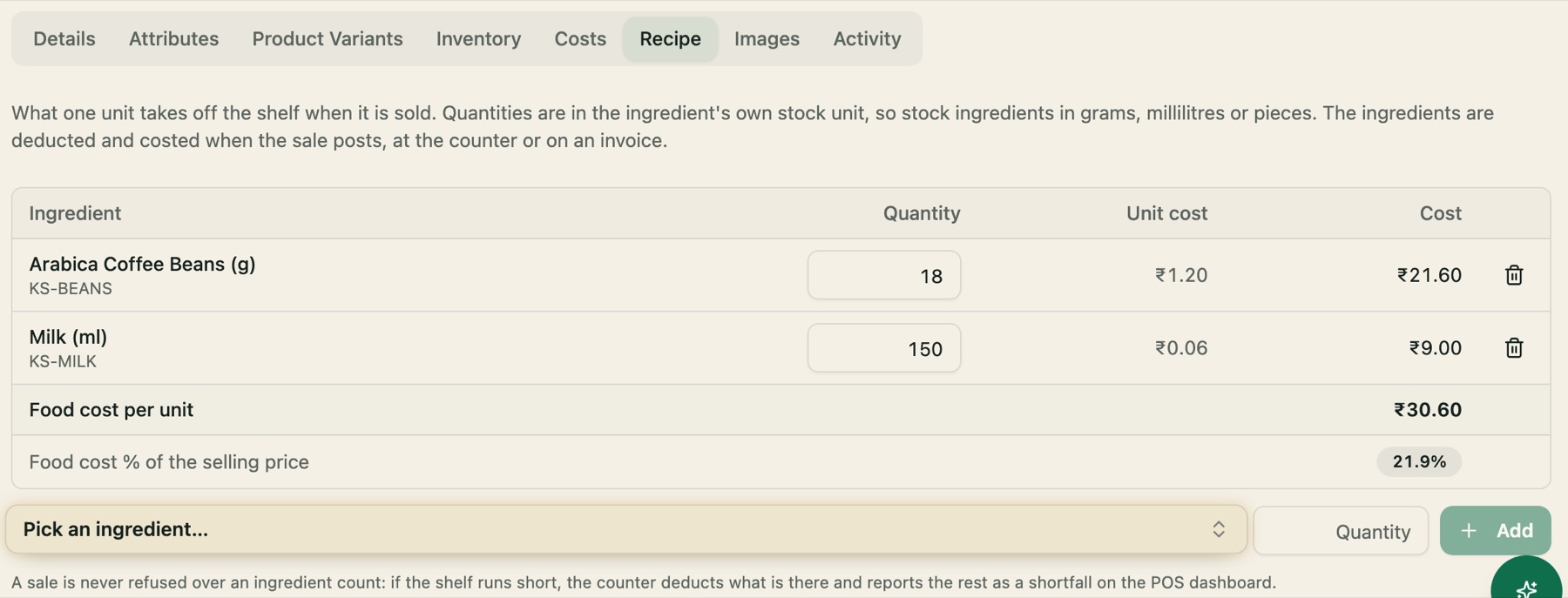
- Recipes that deduct ingredients. A sold dish takes its flour, butter and cream off the shelf, costed first-in-first-out, with the food-cost percentage on the dish. Options count too: extra cheese adds, no onions takes away.
- Tips paid out properly. Pay a server in cash from the drawer or by bank; the tips report shows what is still owed to each.
- Order ahead for pickup. Guests order from your link or QR, choose a collection time, and the order lands on the floor for the kitchen.
- A sale is never refused over an ingredient count. If the shelf runs short, the shortfall is reported on the dashboard for the stock count.
Integrations on request: delivery apps (Talabat, HungerStation, Zomato, Swiggy), and card terminals from your country’s acquirer (Geidea and mada in Saudi Arabia, Pine Labs and Razorpay in India, Stripe elsewhere).
The whole counter
Everything above sits on one product. This is all of it, the same in every edition, whether or not your counter needs each part on day one.
Selling
- Search by name, SKU or barcode; category chips; sort by best-selling or recently sold
- Variants on one card, with a picker; a variant barcode adds that variant directly
- USB and Bluetooth scanners with no setup; camera scanning in the mobile app
- Keyboard shortcuts: F2 search, F4 pay, F6 park, F8 returns, F9 exact cash
- Line and cart discounts, and price overrides, each behind its own permission
- Sold by the piece, kg, metre or litre; weight and price labels from scales
- Options with minimum and maximum choices, priced on the line
- Park a cart with a note and resume it on any counter
- A second screen for the customer; a self-checkout kiosk
- Full-screen register mode; phone and tablet layouts built for touch
Payments
- Cash with quick-amount chips, a keypad and exact cash; change worked out
- Card and bank transfer with a reference, banked to the account you choose
- Gift cards, store credit and loyalty points as tenders
- On account, within the customer’s credit limit
- mada in Saudi Arabia; UPI with a scan-to-pay QR in India
- Split one bill across any number of tenders
- Tips to a liability, never revenue; a service charge by percentage
- Account payments at the counter, oldest invoice first
- Trade-ins and charge-to-room, where the counter uses them
Receipts
- 58 mm and 80 mm thermal slips, printed as an image so every script prints as shown
- Auto-print, and the drawer opens on cash sales
- Email with the invoice PDF attached; WhatsApp with a link to it
- Reprint any sale from Transactions
- The receipt title, tax number and fiscal QR your country requires
- Serial, batch, expiry and HSN on the lines that need them
Customers and loyalty
- Walk-in by default; any customer from the address book in one search
- Customer groups, with their own promotions and price lists
- Price lists with quantity breaks, by group or by counter
- Promotions: percent off, amount off, fixed price, buy X get Y, N for X
- Schedules, days, hours, limits and coupon codes that say why they did not apply
- Points, tiers with multipliers, and punch cards that pay out as store credit
- Gift cards sold, reloaded and voided, booked as a liability
Stock
- Each counter sells from its own location, with live on-hand on every card
- Low stock, out of stock, not stocked here and backorder, per product
- Serial numbers and batches with expiry, soonest-expiry first
- Returns put back the exact unit or batch that came back
- Recipes that take ingredients off the shelf, costed first-in-first-out
- Transfer stock between locations from the counter
- Price and product changes reach open counters without a reload
Cash and trust
- Shifts per counter with a counted float
- Cash in and out with reasons; a mistake is voided with a reversing entry
- Blind count at close, X and Z reports, and the variance
- Every cashier is a real user; switch by PIN, lock the counter to step away
- Permissions checked by the database, not just the screen
- Voids, no-sale drawer opens and sign-ins recorded with a name
Returns
- Return any line or all of them, against the original sale
- Refund in cash, as a credit on the account, or as store credit
- A credit note every time, with its own number
- Returns work offline against the counter’s own copy of the sale
Tables and kitchen
- Floors and tables with seats; table states: free, seated, not sent, bill printed
- Move or merge tables, or move some items onto another table’s bill; the kitchen gets a slip
- Kitchen tickets per station, printed and on a kitchen screen, in rounds
- A kitchen log with time to plate, reprints and cancelled tickets
- Courses and seats; split by item or seat; print the bill before paying
- Comps with a reason, a daily limit per person, a manager PIN past it, and a report
- Guests order from the table by QR, from the categories you choose
- Pickup and delivery orders, with a delivery charge added for you
- Reservations and a waitlist; tips paid out to each server
Offline
- Sales, returns, cash movements and shift open and close all work offline
- Everything queues on the device and posts exactly once when the line returns
- Anything the server refuses stays visible, with the reason, until someone acts
Oversight
- A live dashboard of every counter and outlet, refreshed every 15 seconds
- Sales by hour, tender mix and top items
- Attention flags at thresholds you set: variance, voids, refunds, discounts, no-sales
- Reconciliation: what the counters took against the ledger and the journal
- Reports for tips, comps and ingredient shortfalls
Compliance
- ZATCA Phase 1 QR and Phase 2 clearance in Saudi Arabia
- GSTIN with HSN/SAC in India; TRN in the UAE; VAT numbers elsewhere
- Age checks and prescriptions before the line goes on the bill
- A controlled-drug register, batch recalls and warranty checks by serial
Devices and hardware
- Desktop app for Windows, macOS and Linux
- iPad and Android tablets, and phones; or any browser, installable
- ESC/POS printers on the network, or USB, serial and Bluetooth through the computer
- Cash drawers on the printer’s port; ticket printers per kitchen station
Screens from a demo workspace, “Cardamom Cafe & Store” in Kochi.
See it on your own counter
Start a free trial at my.biza.app, or ask for a walkthrough on your own menu, with your own stations and a real ticket printer. The restaurant guide is at biza.app/docs.